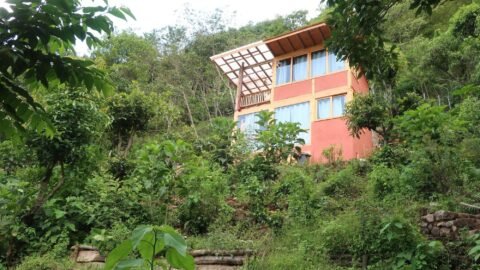
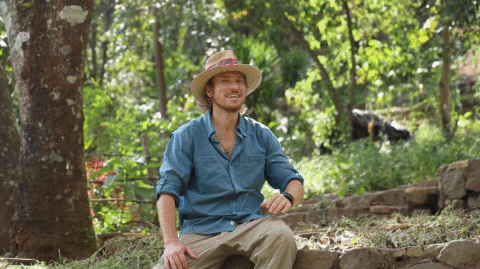
The aroma of freshly brewed coffee mingled with the soft morning light as it slipped through the windows of Casa Melocotón. Cushions shifted, bodies settled. Rodrigo, Silvere, Stefan, and I gathered slowly in our living room—an otherwise ordinary space now quietly holding the weight of something about to begin. We looked around at each other, a few nervous smiles exchanged, uncertain of who would speak first.
Then Rodrigo spoke.
“I want you to close your eyes,” he said gently. He guided us through several cycles of centering breaths—each inhale softening the happenings of our busy moments before arriving, each exhale dropping us deeper into our bodies. “Release any expectations,” he continued, “and instead, get in touch with the deeper reasons that brought you here—to this place, to this project, to this moment.”
As his words settled into the room, so did we. My shoulders dropped. My body softened. Each of us, I imagine, conjured a vision—a flicker of memory, a guiding value, a quiet knowing. Though unique, I know our intentions shared common threads: to model a new way of living in community, to build with reverence for the land, to cultivate belonging, spirit, ecology, and purpose. To co-create a home that offers nourishment, refuge, and inspiration—for us and for many.
By midday, the walls of our living room no longer resembled themselves. Butcher paper stretched from corner to corner, a living map of our collective imagination. Hand-drawn sketches layered with scribbled notes and brightly colored sticky notes turned the space into something between an architect’s studio and a child’s dreamworld. Each corner was alive with possibility. Around the table, we leaned in—moving notes, weighing choices, questioning, dreaming.
At one point, I paused to take in the intricate arrangement of the dwellings and features within our eco-community vision. A wave of exhilaration and overwhelm washed over me simultaneously, as I absorbed the enormity of the plan and the many aspects of life it will nurture and support.
The others turned to me as I succumbed to laughter.
“How you doin’?” asked Stefan.
“We’re in for one wild ride”, I said with a beaming smile.
This was the beginning of WuWei Village’s master plan. And we had two days to give it life.
A Grounded Visioning Process
Over the course of two full days, we moved between high-level dreaming and practical planning. The first day focused on the larger context of Tzununa—its strengths, its gaps, and how WuWei might contribute meaningfully to its evolution. We talked candidly about the rapid changes happening here: development pressures, shifting demographics, and the urgent need for thoughtful, community-driven models.
Through the lens of a market study, we mapped out what already exists—retreat centers, restaurants, eco-projects, and schools. We identified where overlap happens and where new offerings might meet real needs. Our goal wasn’t to compete with our neighbors, but to complement and enhance the local ecosystem with what we build.
The second day brought us into the heart of WuWei’s land. With butcher paper spread across tables and walls, we drew, annotated, moved sticky notes around, and discussed the sequence of spaces. We shifted from town-scale to site-specific, considering each area of the WuWei campus in greater detail. What buildings would support each program? How would the spaces relate to one another, and to the flow of people through them—day visitors, retreat participants, seasonal guests, future residents? Each zone was designed with intention: where people will gather, where they’ll work, where they’ll rest.
We moved between the abstract and the grounded, from visioning to logistics, tuning into the heart of place-making. Residential zones. Communal spaces. Commercial elements to support long-term viability. By day’s end, we had shaped a phased development plan, one that balances inner village life with outward-facing, income-generating offerings. A plan that allows the village to grow organically, rooted in reciprocity with the land and the wider community.
Meet the Team
This charette was a milestone for WuWei Village, and it wouldn’t have been possible without the presence and contributions of a deeply aligned team.
Silvere and I, as WuWei’s co-founders, have been living and building on this land for years. We brought our lived experience and long-term vision to the table—grounding each conversation in our commitment to this place and the values it’s meant to hold.
Stefan Bird, an advisor and investor in WuWei, brought a wealth of experience in sustainable real estate development and systems-level thinking. He’s the managing partner at Bird House Atitlan, with career experience in large scale-solar projects, residential community development, and biophilic design. Stefan holds a Master’s in Real Estate Development from MIT and a background in construction management. His ability to hold both the big picture and the building blocks helped shape the structure of our plan.
Rodrigo Cabrera, our facilitator and design lead, is an architect with a Master’s in Sustainable Housing from Universitat Politècnica de Catalunya. He also holds a degree in Architecture from Universidad Francisco Marroquín, where he once taught. Rodrigo’s past work includes leading community-driven innovation projects at the Municipality of Guatemala, and today he works as a development counselor with a keen sense for sustainable, context-sensitive design. His guidance was foundational to the depth and coherence of the process.
What’s Next
We’re now in the process of refining the WuWei Village master plan with Rodrigo—integrating feedback, finalizing layout details, and beginning to align the design with local construction realities and phased timelines.
This charette wasn’t just about dreaming; it was about laying the groundwork for something tangible. The ideas we sketched and the decisions we made are already influencing how we move forward. A village is beginning to take shape—layer by layer, zone by zone, rooted in intention and designed for resilience.
There’s much more to come. As the vision continues to unfold, we look forward to sharing what’s next—with all the possibility and purpose that this place is meant to hold.
The village is on the way.