When we started planning WuWei Village, one of the first things people asked was simple:
“So can I buy a lot?”
It’s a fair question. When most people think about investing in a piece of land, especially somewhere as extraordinary as the valley above Lake Atitlán, their instinct is to own a defined piece of it. A deed with their name on it. A parcel they can point to on a map.
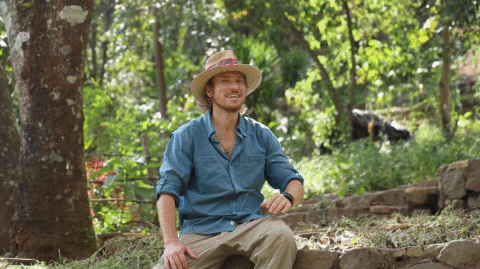
We thought hard about that model. Silvere and I spent many hours discussing different ownership structures and imagining how each one might shape the future culture of the village. In the end, we decided against selling lots. Not because ownership is bad, but because individual parcels work against the very thing we’re trying to build.
The Problem with Lots
When you subdivide land into private parcels, something subtle but consequential happens: interests begin to diverge.
One owner wants to build now. Another wants to wait. A third has different ideas about what belongs on the southern terrace. Someone leaves and sells to a buyer who shares their desired house size but not their values.
You’ve seen this play out in communities all over the world. Well-intentioned projects that fragment ownership often end up fragmenting culture. The commons get neglected because everyone is focused on their piece. The food forest doesn’t get tended because nobody is quite sure whose responsibility it is. Revenue generated within the community flows into separate pockets rather than being reinvested into the village itself.
A community where interests are divided is not really a community. It’s a neighborhood.
Many wonderful neighborhoods function exactly this way.
But we weren’t trying to build a neighborhood.
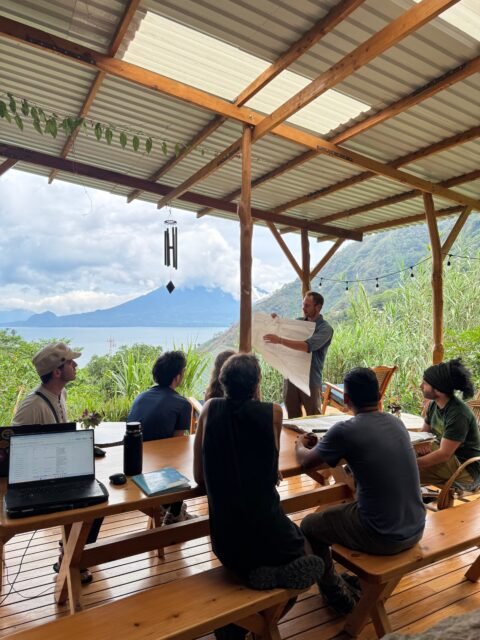
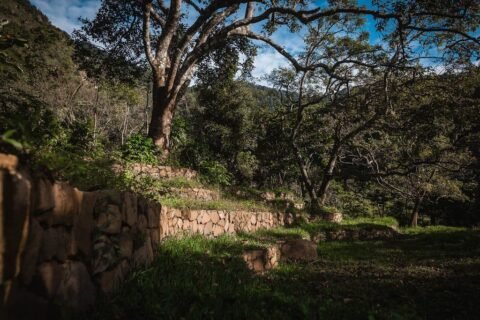
We wanted to build a village. A living system where the food forest, the homes, the retreat spaces, the rivers, and the waterfalls are all part of one interconnected whole. That vision required a different ownership structure.
What We Built Instead
WuWei Village operates as a Sociedad Anónima, a Guatemalan legal holding company that owns all of the land and assets of the project.
Investors don’t buy lots. They acquire shares in the company.
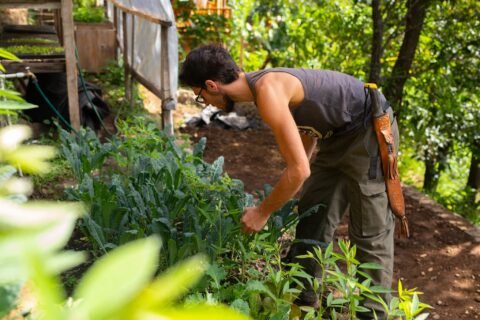
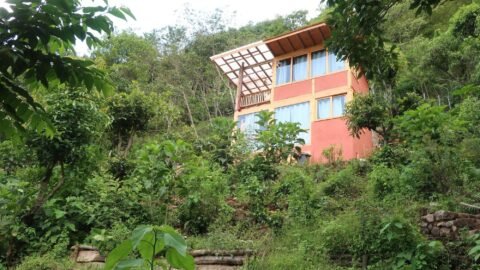
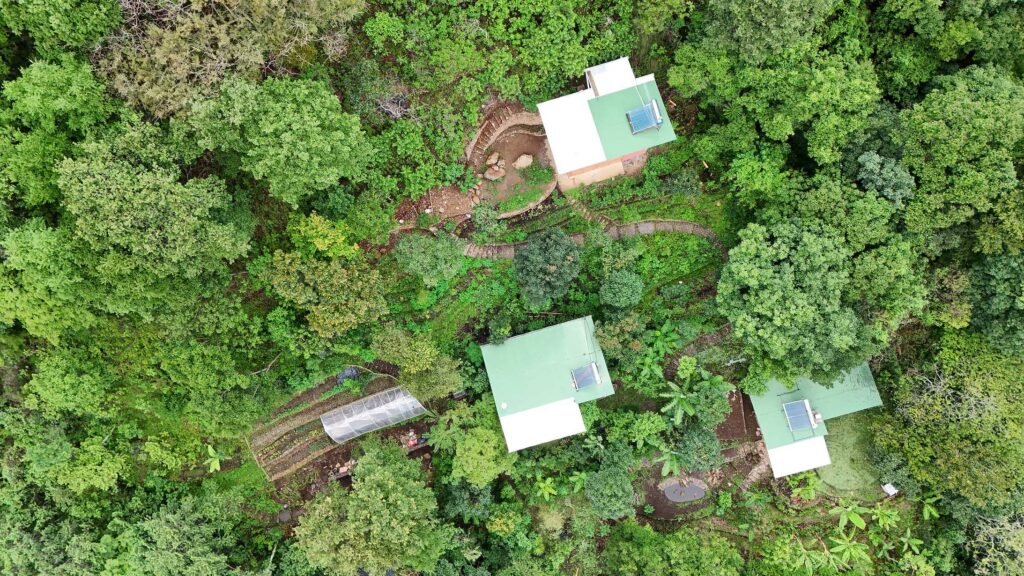
Those 200,000 shares represent proportional ownership of everything: the three-hectare landholding in Tzununá, the homes that have already been built, the food forest that grows more productive each year, the infrastructure, future hospitality offerings, retreat spaces, and the many assets that will emerge as the village continues to develop.
As we build, as revenue is generated, and as the village matures, the underlying value of the enterprise grows alongside it.
It’s a model that has been used in cooperatives, community land trusts, and intentional communities for decades. What drew us to it was its ability to align ownership with the long-term health of the entire project.
Why We Believe This Creates More Value
One of the things that attracted us to this model is that it allows value to be created across the entire ecosystem rather than within isolated parcels.
When revenue from Airbnb rentals, retreat visitors, and future residents flows back into the holding company, it can fund the next phase of development. New infrastructure supports future growth. New amenities improve the experience of residents and guests. Productive agroforestry systems strengthen both ecological and financial resilience.
Each improvement strengthens the village as a whole.
The food forest becomes more productive over time. Hospitality offerings attract visitors and generate income. Shared spaces enrich community life. Every piece contributes to the vitality of the larger ecosystem.
By contrast, a lot-based model limits value creation primarily to the appreciation of an individual parcel. At WuWei, shareholders participate in the growth of the entire village.
What Shareholders Actually Get
Beyond the financial mechanics, shareholders receive something that is harder to quantify: preferential access.
With residential opportunities intentionally limited and a community defined by shared values rather than geography, being a shareholder means having a place within the unfolding story of the village, not just financially, but culturally.
Shareholders are invited to community events, receive discounted rates on stays and retreats, and for those who may eventually wish to live here, have priority consideration as future residential opportunities become available.
It’s the difference between owning real estate and participating in the stewardship of a place.
A Note on How We Chose This Structure
We also want to be transparent about another reason we chose this model: it helps protect the community from fragmentation during its early years.
During the development stage, shareholders are asked to hold their investment for a minimum of five years. That window creates stability while the village is still being built and allows us to focus on long-term value rather than short-term speculation.
It also helps ensure that the people around the table are here for the right reasons.
We take time to get to know prospective investors because shared values matter. Buildings can be constructed relatively quickly. Community takes much longer. The culture of a place emerges through relationships, stewardship, and a shared commitment to the future.
If, after the holding period, a shareholder decides that WuWei is no longer the right fit, shares can be sold to another aligned buyer. The ownership structure remains intact. The culture remains protected. The vision continues to move forward.
That’s not a restriction on investors. It’s one of the mechanisms that helps preserve the value of what everyone is helping build together.
Looking Ahead
For us, the decision not to sell lots was never primarily a financial one.
It was a decision about stewardship.
We wanted to create a structure that encourages people to think beyond individual property lines and toward the health of the whole. A structure that allows the land, the community, and the businesses that emerge here to grow together.
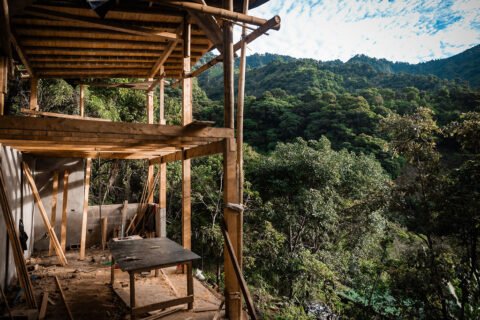
WuWei Village is still in its early chapters. The food forests are growing. New spaces are taking shape. The vision continues to evolve with each season.
But this foundation already shapes every decision we make.
WuWei Village is currently open for Phase 2 investment. Shares are priced at $20. If you’d like to understand the structure in more detail, the investor brief is a good place to start — reach out at w%75wei.v%69%6c%6ca%67e%40g%6dail.%63om.