“Regenerative” has become one of those words. You see it on juice bottles, hotel websites, real estate brochures. It has the warm glow of something meaningful without always doing the work of explaining what it actually means.
We use it too, at WuWei Village. So we want to earn it.
Living regenerative is a way of life here. It’s why Earth Care is the first of our guiding pillars, not the third or the fourth. We are heartbroken by the way much of the world operates, by economic systems that define progress as extracting more than the earth can sustainably provide, built in the absence of any reverence for what we receive. At WuWei, we’re striving to set an alternative example: to lead as a model for a way of life that is harmonious with our planet, and to remember our rightful place as beneficial organisms within our ecosystems, not separate from them.
Here’s what that looks like on our land, specifically, practically, and in terms you don’t need a permaculture certification to understand.
What the Land Was, and What It’s Becoming
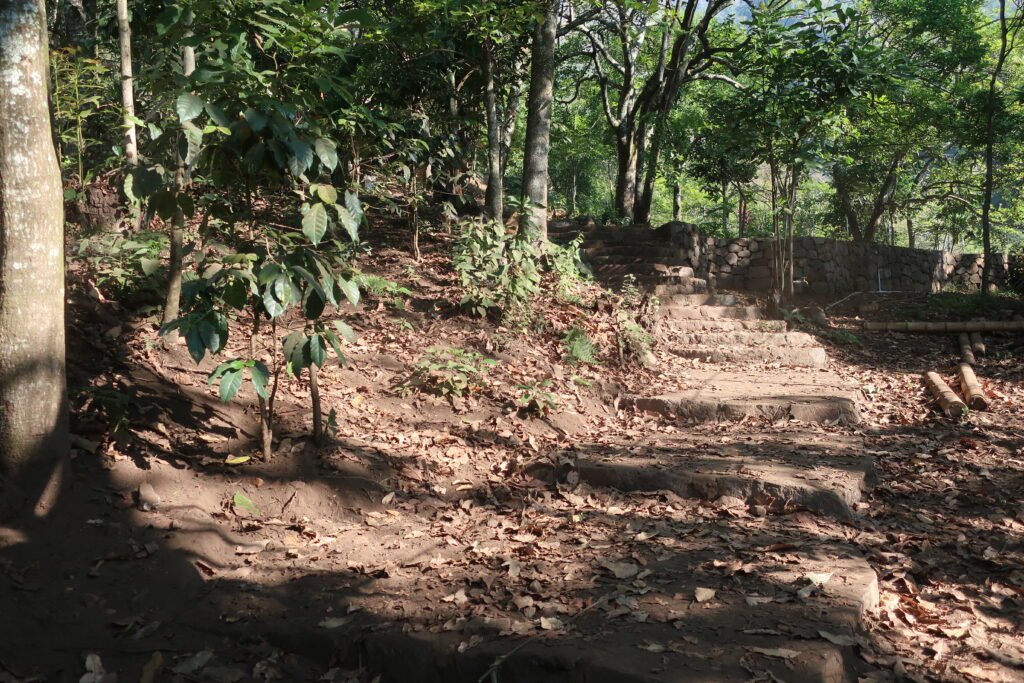
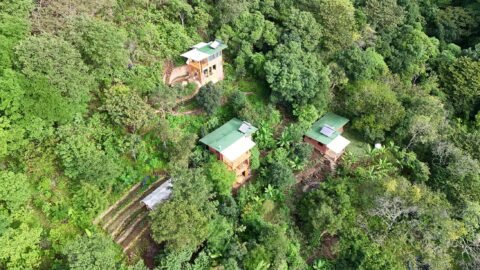
The 3-hectare (roughly 7.4 acre) site in the Tzununá Valley above Lake Atitlán was not pristine jungle when we arrived. Much of it was steeply sloped, dusty, exposed soil, heavily planted in coffee, a single crop covering the hillside with little else growing beneath or around it. That’s a familiar story for a lot of land in the Guatemalan highlands.
Regenerative development means we’re not just building on that land. We’re working to return it to a higher state of ecological health than we found it. Each year, the land should be more fertile, more biodiverse, and more productive than the year before, not despite our presence, but because of it.
The goal is not to leave the land as we found it. The goal is to leave it better.
Syntropic Agriculture: What It Actually Is
The primary tool we use on the land is syntropic agriculture, a regenerative farming approach developed by Swiss-Brazilian farmer Ernst Götsch, based on decades of applied work transforming degraded land in Brazil.
The word “syntropic” comes from syntropy, essentially the opposite of entropy. While entropy describes systems breaking down, syntropy describes systems building up: becoming more complex, more diverse, more alive over time.
In practical terms, syntropic agriculture mimics the natural structure and succession of a forest. Rather than planting monocultures that deplete the soil, you plant in layers: tall canopy trees, mid-level fruit trees, ground-level crops, and root vegetables, in a system where each element supports the others. Fast-growing pioneer plants are pruned at strategic intervals; the biomass becomes mulch that feeds the soil. Over time, the system becomes self-sustaining and increasingly productive.
The science behind it is compelling. Syntropic systems can build up to two inches of humus annually, the rich, life-giving topsoil that conventional farming depletes. They sequester carbon, restore watersheds, attract biodiversity, and produce food without external chemical inputs. The harvest, as Götsch puts it, is a side effect of ecosystem regeneration.
What This Looks Like at WuWei
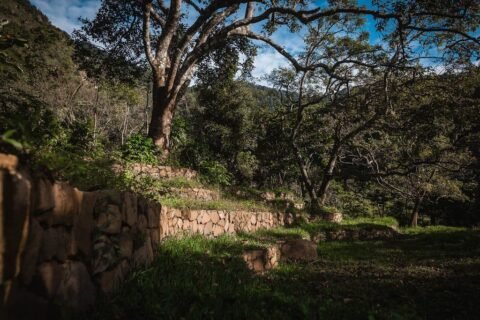
Walk the terraces at WuWei Village today and you’ll find banana trees, cacao, medicinal herbs, fruit trees, and leafy crops growing together in planned succession, where a single crop of coffee once stood alone. The slopes, once bare and exposed, are being stabilized by root systems and covered by a living mulch that builds the soil year after year.
The communal kitchen garden produces food for the household. The food forest, still in its early succession stages, is beginning to show what it will become: a productive, multi-layered landscape that will supply food, medicine, and biomass to the village for decades.
We also steward three off-property waterfalls within hiking distance of the village: a 150-foot jungle waterfall that is among the tallest in the region, and two more accessible falls along gentler trails. These are not commercial attractions. They’re protected natural assets held under the village’s stewardship, a commitment to the idea that some things should remain wild and shared.
Natural Building: Architecture from the Earth
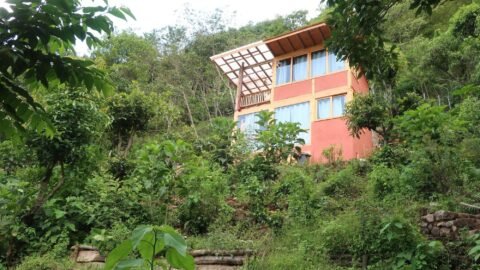
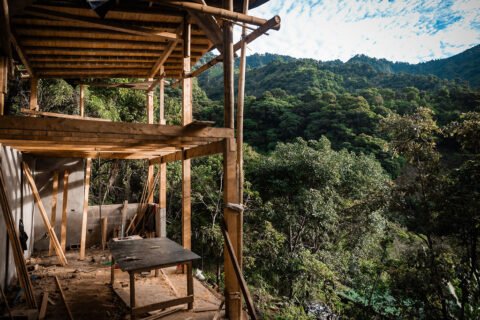
Regenerative land stewardship extends to how we build. The homes at WuWei Village, including the recently completed Casa Orquidea, are constructed with natural materials: earth, wood, stone, and lime plaster. These materials have minimal embodied carbon, regulate temperature naturally, and integrate with the landscape rather than sitting on top of it.
Natural building is slower and more skilled than conventional construction. It is also more beautiful, more durable in the right conditions, and fundamentally more honest about where materials come from and where they will go.
Why This Matters for Investors
We include this not to make a philosophical point, but a financial one.
Regenerative land management increases the value of the underlying asset over time. A food forest that matures becomes more productive, not less. Soil that builds year over year increases the agricultural and ecological value of the land. A property that is genuinely regenerative, with waterfalls, biodiversity, and productive food systems, commands a premium in a market that is rapidly recognizing the difference between development that depletes and development that restores.
WuWei’s land is getting better. That’s not a tagline. It’s a design principle with measurable outcomes, and it’s part of what backs the value of every share.
But it’s also more than an investment thesis. It’s a practice. Every terrace we plant, every wall we build from the earth beneath it, is a small act of remembering: that we belong to this land as much as it belongs to us, and that our task here is not to take from it, but to help it flourish. That’s the world we’re trying to build at WuWei Village, one hillside at a time.
Interested in seeing the master plan and the financial projections? We’re happy to share both with aligned investors. Reach out at %77%75%77%65i.vi%6clage@g%6d%61il%2eco%6d or visit wuweivillage.com.